


Commercial -
Auckland CBD landmark stands out from the crowd
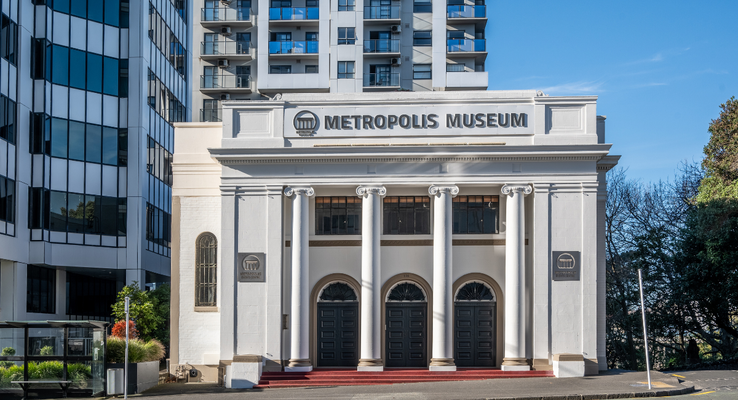
An Auckland landmark that has spent more than 90 years commanding attention on one of the city’s busiest arterial routes is being brought to market, offering the opportunity to secure a property where architecture, visibility and identity converge, Bayleys brokers say.
Bayleys Metro Markets’ director, Tommy Zhang, together with colleague Phil Haydock, is marketing the 579sqm (more or less) site at 116 Symonds Street for sale by tender, closing at 4:00 pm on Tuesday, 28th July 2026 (unless sold prior).
Occupying a prominent corner position opposite New Zealand’s largest hotel, the property comprises a standalone heritage building of 602sqm (more or less) that currently houses New Zealand Rescue and offers a level of profile rarely available in Auckland’s CBD.
Constructed in 1933 as a place of worship and designed by English-born architect Charles Towle, the Category B heritage building remains one of Symonds Street’s most recognisable landmarks.
Zhang says its imposing Graeco-Roman façade, towering columns and elevated position overlooking the city have made it a defining feature of the streetscape for generations.
The opportunity comes to market as Auckland Central continues to strengthen on the back of renewed tourism activity, growing international student enrolments, and significant public and private investment that is reshaping the city centre.
The recently opened New Zealand International Convention Centre (NZICC), continued investment in transport infrastructure such as the nearby Karanga-a-Hape City Rail Link (CRL) station, and increasing activity across the education, hospitality and accommodation sectors are contributing to growing confidence in the CBD.
Zhang says that against this backdrop, buildings capable of delivering genuine presence and differentiation are generating competitive interest, with organisations recognising that real estate can contribute meaningfully to both brand identity and operational performance.
“Many commercial buildings provide accommodation, but few create a lasting impression. This is the type of property people remember. Whether it’s a professional services firm, educational institution, cultural organisation, or a private occupier, there is value in occupying a building that immediately distinguishes itself from its surroundings.
“While heritage buildings remain an important part of Auckland’s architectural fabric, opportunities to acquire well-presented, seismically strengthened, and standalone examples are increasingly uncommon,” he says.
The building has been carefully adapted for contemporary use, including seismic strengthening to 80 percent of New Building Standard, creating highly functional premises while preserving the architectural character that defines the property.
Internally, the property features a grand mix of open-plan spaces, offices, meeting rooms, and amenities, providing flexibility for a range of occupiers. The basement provides 10 secure, covered car parks – a significant advantage in a precinct where parking remains at a premium.
Located within walking distance of the University of Auckland, AUT, Auckland Hospital, Auckland Domain and Queen Street, the property sits at the intersection of several of Auckland’s most important education, health and commercial precincts. Immediate access to the Grafton Gully motorway interchange also provides efficient connections across the wider region.
The site is zoned Business – City Centre, Auckland’s premier commercial zoning, which supports a range of business, educational, hospitality, and mixed-use activities.
Bayleys Metro Markets’ director, Phil Haydock, says its appeal lies in a combination of location, functionality and architectural significance.
“The qualities that make this building distinctive are also what make opportunities like it increasingly scarce. Heritage protections, planning requirements, and construction costs have created a market in which landmark standalone buildings of this quality are impossible to reproduce.
“That scarcity has value. Whether viewed through an investment lens or as a future business headquarters, buildings with genuine identity continue to attract attention, command loyalty and outperform in one area that cannot be manufactured: they are remembered.”
Contact us


